Friday, November 9, 2012

It's time to FOCUS on Restoring the GOP to the Party of Liberty


The crushing defeat of the Republican Party on election day has obviously unleashed a barrage of questions and commentary. Where did the GOP go wrong? In my humble opinion, the Republican Party failed miserably at distinguishing itself from the Democratic Party. Moreover, the baggage of the intolerant social conservatives, the Republican addiction to spending and the label of being the War Party weighed heavily in the GOP's defeat. The Republican Party is a turn off for voters and the GOP was hit especially hard on demographics by losing the youth vote, the female vote and the minority vote.  In many ways, the GOP is viewed as the party of old, white, gray and dying establishment Republicans as noted in a piece titled GOP Challenge: How to Transcend Aging White Base.

One thing is clear. The GOP has BIG problems that were succinctly and accurately summarized by a Facebook friend.  
The GOP is now made up of 3 factions. The old guard, which I completely reject, the Tea Party, which I almost completely reject due to their batshit crazy tendencies, and the Libertarian wing which I fully endorse.
The war for the soul of the Republican Party has begun. If the Libertarian wing doesn't prevail, the GOP is headed straight to the trash heap of permanent extinction because of a vanishing base. While the Washington Post came out with Republican Party begins election review to find out what went wrong, a far more interesting analysis lays out what needs to be done.

Tea Party: No More Doles, McCains, Romneys
Following President Barack Obama’s re-election victory on Tuesday, one Tea Party group is vowing “no retreat” in its quest to find candidates with “clear conservative records” instead of “weak-kneed” Republicans.

“We’ve had Bob Dole, we’ve had (Gerald) Ford, we had (John) McCain, and now we did (Mitt) Romney, and they lost…because those guys do not necessarily reflect what I think the majority of conservatives, probably the majority of Americans, truly believe,” said Scottie Hughes, news director for the Tea Party News Network.

Hughes added that a desirable conservative candidate is someone who advocates “core principles,” such as liberty, freedom, and limited government, which were so important to the Founding Fathers.

Todd Cefaratti, a TPNN editor, says he knows what conservatives need to do to regain control of the White House: “The Tea Party has not yet begun to fight. It’s time for a wholesale reassessment of the D.C. establishment politicians and party grandees who have no commitment or courage to reduce the size of government,” Cefaratti said.

“[But] unfortunately, time and time again the establishment Republican Party continually keeps putting these candidates [forward], saying, ‘This is who we need to support.’ And most of the time those are usually not the folks who represent true conservative Republican values,” said Hughes.

Hughes said that if conservative and libertarian groups found a way to combine forces, they might be able to settle on a candidate who could win without the need to appeal to moderates.
Bingo!

Therein lies the hope for resurrecting the GOP from the utter destruction wrought upon it by the arrogant party elites who hold the will of the conservative base in the highest contempt.  Also, Republican salvation definitely won't be coming from theocratic candidates like Michelle Bachmann or Rick Santorum.  The Republican Party needs to ditch its 'bat shit crazies' who advocate for theocracy, social intolerance, endless wars and a military empire.  The theocon/neocon axis must be broken and consigned to the trash heap of history.

Conservatives are different than Democrats. A Democrat will vote for any idiot their party runs but conservatives absolutely will not. Conservatives will gleefully and vigorously punish their party for running big government and big spending Republican statists, and that's precisely what happened on election night.

For decades conservatives have been voting for what they perceived as less government but all they ever got was more Republican spending, more deficits and a big pile of debt. The crop of Tea Party Republicans that won big in 2010 ended up spending more than the Democrats they replaced, here.  The decline and fall of the Republican Party dates all the way back to the Reagan era.

What Went Wrong with the Republican Party? Reagan Ruined the Republican Party and Fiscal Conservatism
Lew Rockwell published this gem of a 1992 piece by Murray Rothbard describing the fall of the Republican Party as fiscal conservatives. The article documents the turning point of the Republican Party under Reagan. Frankly, I never understood why Reagan is so revered by Republicans. Reagan massively increased spending and taxes. In many way, the Reagan era paved the way for the Republican Party nightmare that currently exists - nothing but a party of one big socialist spending orgy. As it turns out, the Gipper was one big graft machine who loved big government.

Repudiating the National Debt

In the spring of 1981, conservative Republicans in the House of Representatives cried. They cried because, in the first flush of the Reagan Revolution that was supposed to bring drastic cuts in taxes and government spending, as well as a balanced budget, they were being asked by the White House and their own leadership to vote for an increase in the statutory limit on the federal public debt, which was then scraping the legal ceiling of $1 trillion. They cried because all of their lives they had voted against an increase in public debt, and now they were being asked, by their own party and their own movement, to violate their lifelong principles. The White House and its leadership assured them that this breach in principle would be their last: that it was necessary for one last increase in the debt limit to give President Reagan a chance to bring about a balanced budget and to begin to reduce the debt. Many of these Republicans tearfully announced that they were taking this fateful step because they deeply trusted their president, who would not let them down.

Famous last words. In a sense, the Reagan handlers were right: there were no more tears, no more complaints, because the principles themselves were quickly forgotten, swept into the dustbin of history.
On Tuesday night, November 6, 2012, true conservatives just couldn't take it any longer. They were sick to death of years and decades of lies, spending, deficits and debt. Conservatives finally found the courage to just let the Republican Party loose, something that was long overdue.

Frankly, I'm proud of conservatives for finally doing something they should have done a long time ago. They finally had the testicular fortitude to fire their own damn party because the lesser of the two evils is still evil.

It's time for We the People to take back the Republican Party and toss out the frauds and traitors who betrayed the constitution and the principles of federalism and limited federal powers.

Thursday, November 8, 2012

Is the Republican Party Toast?


As post election day drama and trauma pile up, the future of the Republican Party tops the agenda. Some are even speculating whether or not the GOP even has a future.

 Republicans Are Becoming Irrelevant, and That is Frightening For the Future of America
As for the future of the Republican Party, I’ve had every liberal friend I know texting and e-mailing me over the last 24 hours offering me advice on the soul-searching the GOP needs to do — from dumping the ultra religious moral crusaders of the evangelical right to losing the economic and small government arguments of the Tea Party, which I find puzzling. If we did all that, essentially what would make us any different from the Democratic Party? More government vs. more government? More spending vs. more spending? More taxes vs. more taxes? Every election would basically just be a choice between two left-wing ideologies. Coke and Pepsi (then the Libertarian Party would really have an argument about presenting a different option).

Look, I’ve said this time and time again till I’m blue in the face: When I say I support smaller government across the board, I mean it. I don’t believe government has any more right or authority to tell women who can and can’t have children or tell couples who can and can’t get married than it should be running every aspect of our system from health care and finance to energy and education. The Chicago Young Republicans are as diverse as the city we live in. As a group of over 1,000 members, we have more females than males. We have African-Americans, Latino-Americans and LGBTs because the values that unite us all are free market principles, private sector solutions and a constitutionally-limited government. We can’t control what some Senate candidate in Missouri or Indiana says, which is a burden those states’ primary voters must bear; nor can I tell every Republican in America what to think, say, and do.

But our losses were more than just Todd Akin and Richard Mourdock. There’s no doubt America has socially shifted to a center-left nation. We also lost in purple states like Florida, Virginia, and Ohio because I believe America has economically shifted to a center-left nation as well.
I do believe that America is center left on the social issues and that the social conservatives have literally driven folks away from the Republican Party. However, I do not agree that America is overall a center left nation. Moreover, the Republican Party absolutely lost voters by emulating the Democrats and being big spenders who pile up the debt. The national debt increased by $5 trillion during the Bush years.

As a Libertarian leaning fiscal conservative who hates the spending and debt, I quit voting Republican in 2006 simply because Republican socialism wasn't any less painful or destructive than Democratic socialism. As election results prove, I'm not alone.

One of the most annoying things that Republicans do is accuse the Democrats of being socialists while believing the delusion that Republicans are in fact fiscal conservatives. It's always a LOL moment. The truth?

The Tea Party Republicans Spent More Than the Dems They Replaced.
Can you hear the screeching roars of the Tea Party Republicans accusing the Dems of being socialists, commies, fascists, Marxists, big spenders and a whole lot worse?

Well, as it turns out, the Republicans and the Tea Party crop of Republican Congress Critters that sailed into the District of Crime in January, 2011 to clean up the Democrat fiscal mess turned out to be bigger deficit spending hawks than the Democrats they replaced....

The approximately $1.59 trillion in new debt accumulated since the Republican-controlled House gained a veto over federal spending legislation is more than the total increase in the federal debt between 1789, when the first Congress convened, and October 1984, when the 98th Congress was nearing the end of its second session.


How about Obama being the food stamp president?

Bush is the REAL Food Stamp President
Republicans just can't stop calling Obama 'The Food Stamp President'. However, the truth is quite different and Bush and the Republicans are responsible for massively expanding the food stamp program....

President Bush dramatically expanded eligibility, restoring benefits to nearly a million individuals at the beginning of 2003, and paving the way for the program to expand as it did during the rest of presidency. As a result, Bush managed to oversee unprecedented growth in the program even as the economy grew. Obama then followed up on this with an eligibility expansion of his own in the 2009 stimulus package. It’s not unreasonable to criticize Obama for the expansion of the food stamps program under his watch. But Obama's Republican critics shouldn’t forget that it was a GOP president who helped make that expansion possible.
Not only is Republican hypocrisy outrageous beyond belief, Republican socialism isn't any different than the Democrat version. Yet, when I confront Republicans on entitlements and fiscal issues, they inform me that they aren't socialists, just compassionate conservatives. Huh?

So as fiscal conservatives, Libertarians, constitutionalists and advocates for small government flee the big government socialist GOP, the Republican Party that has no grip on the reality on the ground is scratching its head in utter bewilderment.

At the root of the GOP's problems lies the stiffling Republican base that refuses to hold Republicans accountable, so long as Republicans continue to scream "rape is legitimate, kill the Muslims, bomb Iran, outlaw homosexuality, ban gay marriage, ban abortion under all circumstances and for any reason, and crush constitutional civil liberties with the Patriot Act and NDAA".

That's the pathetic state of the Republican Party.  The only question remaining is whether or not there are enough sane small government conservatives left in America to take back the Republican Party from the socialists, statists and theocrats.

As for the wars and foreign policy, that's another issue for another day.

Wednesday, November 7, 2012

The Dawn of Hope: Time for GOP Soul Searching on Why it Failed


The Republicans were badly battered Tuesday night in the general election.  Without Florida's results, Obama cleaned Romney's clock 303-206.  That's quite a bruising in an election cycle that the Republicans should have easily won considering the miserable state of the economy. The Republicans lost Senate seats they should have won because of outrageous 'legitimate rape' comments by socially conservative candidates and they even lost a few House seats.

More to the point, the Republican Party is disintegrating because it literally has 3 factions that do not peacefully co-exist: 1. the New England styled Rockefeller big government Republicans 2. the social conservatives who tend to only vote their so-called intolerant values and 3. the spirited assortment of Tea Party reformers, Libertarians, Ron Paul supporters, Independents and other fed up conservative voting blocks who can no longer even hold their noses and vote for big spending, big government Republicans.  The GOP can no longer hold its fractious base together; hence, it's got a dwindling base and the problem has existed since 2006.

Let's start with Mitt Romney.  He really only had to campaign on 3 issues because in politics, the message is everything.  The American people, especially fiscal conservatives to Libertarian leaning types, are fed up with the endless wars, the nasty economy, the corruption in the District of Crime (DC) and mountains of spending and debt.  All Romney had to do to win was pounce on these 3 issues over and over:

1.  Support military spending sequestration and promise to bring foreign policy out of the closet and put it on the table for a real bipartisan debate simply because we can't afford the existing  foreign policy.  But what did Romney do?  He appeased the military gods and promised to increase military spending by over $2 trillion.  Military spending is not the same as defense spending.  We need to understand the difference because there are indeed legitimate national defense needs that do not include traipsing around the planet in a display of muscular military might that includes costly bombings, invasions, occupations, very expensive rebuilding, civilian death tolls and deadly drone bombings.

2. With an ailing economy, Romney should have focused on why America is bleeding jobs, namely that US corporate taxes are the highest in the industrialized world and Fedzilla's monstrous regulatory apparatus is strangling the economy by driving jobs offshore.  What Romney should have done was campaign on ending the corporate tax - that's right - reduce it to ZERO, and reign in destructive regulatory powers.

3.  Most Americans absolutely do perceive that corruption in the District of Crime is epidemic as well as a finely tuned system of patronage, crony capitalism, corporatism, bailouts and corporate welfare.  All Romney had to do was campaign on NO bankster or corporation bailouts and subsidies.

The fatal flaw of the Republican Party is that it truly believes that all it has to do to win elections is fire up the defense hawks and the religious right.  The formula is no longer working.  Even more interesting is that voter turnout was down 14 million over 2008.

Early figures show fewer Americans cast votes in 2012 race than in 2008
With 97 percent of precincts reporting, The Associated Press’ figures showed more than 118 million people had voted in the White House race, but that number will go up as more votes are counted. In 2008, 131 million people cast ballots for president, according to the Federal Election Commission.

Experts calculate turnout in different ways based on who they consider eligible voters. A separate, preliminary estimate from George Mason University’s Michael McDonald put the 2012 turnout rate at 60 percent of eligible voters.
Let's move on to the Senate.

Before the election results, the Democrats controlled the US Senate with 51 Democrats, 47 Republicans and 2 Independents who typically vote with the Democrats.  The day after the 2012 election, the Democrats will have 52 Senate seats and the Republicans are down to 45 (Politico).  The Republican Party is famous for running hardcore social conservatives in the US Senate, something they can get away with in a House race simply because the districts are carved out to guarantee perpetual Republican or Democrat victories.  A Senate race, however, is statewide and is highly susceptible to a myriad of factors.

Obama didn't win because of his job performance or popularity; he was re-elected because he was perceived as the lesser of the two evils.  The Republicans managed to reinvent themselves as the reincarnation of big spending, warmongering George Bush.  In 2008, I remember talking to Republicans who greatly feared John McCain because they felt that he was so mentally unstable that if he had the nuclear button to push, he'd push it.  Incredibly,  Republican Party has also succeeded in branding itself the socially intolerant War Party.

In 2010, the Republicans stood an excellent chance of winning 2 Senate seats in Colorado and Nevada (Harry Reid was facing a tough re-election campaign). But the social conservatives who dominate the Republican primary voting base nominated Sharon Angle to run against the seasoned and ferocious campaigner Harry Reid, and Ken Buck for the Colorado senate seat. Harry Reid was vulnerable and even a liberal commentator noted that a wet noodle could have defeated Reid. Both Angle and Buck lost. Why? They were not only pro-life but they were radically pro-life and both endorsed the position that human life begins at the precise moment of conception, that all abortion under any circumstances should be outlawed and that America needed a constitutional amendment defining human life as beginning at the precise moment of conception.  That is definitely not a position that appeals to most voters and it's also a position that is a guaranteed ballot box loser.

Christine O'Donnell, of the "I am not a witch" Sarah Palin endorsed variety, lost her Senate bid in Delaware but that was probably expected in a reliably blue state.

It's 2012 and the Republicans once again had an opportunity to take the senate.  In Indiana, Richard Mourdock defeated the aging veteran GOP'er Richard Lugar in a primary, and was considered a shoe-in.  In Misouri, Todd Akin stood an excellent chance of defeating Democrat incumbent Claire McCaskell in a general election.  But once Akin let loose with his now infamous "legitimate rape" comment, he started sinking in the polls.  Mourdock followed up with an Akin styled rape comment and his advantage started to also sink.  Both Akin and Mourdock lost.  In fact, McCaskill crushed Akin 54.7% to 39.2%.  How's that for a voter referendum on a contentious social issue?

Republicans will opine that their presidential candidate was flawed.  In reality, it's the Republican message that is deeply flawed.  Yeah, Mitt Romney was a flip-flopping candidate but that's not unusual with the political class.  What really sunk the GOP Tuesday night is the total lack of a viable message to solve big problems combined with social conservatives who scare voters away.

Moving forward, I do believe that the conservative movement has an awesome opportunity to rebuild the party and get rid of its destructive elitist command and control hierarchy that is arrogant and clueless beyond belief. I also believe that there is an energized youth movement to get the Republican Party back on track by advocating for less federal powers, less spending, less war and less civil liberty crushing legislation like the Patriot Act and NDAA.  The District of Crime has become a feeding trough for voracious corporatist pigs gorging on tax dollars as well as a gargantuan symbol of the concentration of wealth and power.

Winning the future and winning the hearts and minds of the people by advocating for peace, liberty and prosperity absolutely requires shoveling out the filth, rot and decay that has destroyed American conservatism and infested the Republican Party with a fatal disease.

Losing isn't the worst thing that can happen.  Losing should be a time for profound soul searching to figure out what has gone wrong and why.  Losing can be replenishing, cleansing and ultimately a good thing.  The Republican Party stands no chance of ever rising again until the day dawns when the GOP actually stands for something besides big government, big spending, big deficits, big piles of debt, big corporate welfare, big bankster bailouts and endless wars.

Conservatives, liberty activists, constitutionalists and fiscal conservatives now have an awesome opportunity. Will they blow it, again?

Friday, November 2, 2012

Hurricanes, Sandy, Federal Flood Insurance and the Environment


The above photo is from a stunning collection of before and after Hurricane Sandy satellite photos, here.  The devastating was indeed enormous and it's been estimated that the cost of Sandy could approach $50-100 billion. The human misery and suffering following Sandy has been intense and prolonged in some areas.  Meanwhile, God, conspiracy and the politics of environmentalism have entered the picture. The religious right is claiming that Sandy was an act of God as punishment because America is a sinful nation.  The conspiracy theorists attribute Sandy to a man made event utilizing HAARP technology, here.   The environmentalists have attributed Sandy to global warming and some even oppose the rebuilding of ravaged areas.  Meanwhile, ordinary Americans yawn and tell themselves that hurricanes really do happen and have always happened as an act of nature.  Of course, they do.

While I don't buy into the global warming globaloney, I do believe that the environmentalists have come closer to getting it right.  Unfortunately, the environmentalists tend to be radical lovers of statism and seek government solutions to every possible problem.  After Sandy, the time has perhaps arrived to bring the issue to the table because storms and hurricanes are exceedingly expensive as well as devastating.

The Decade's Worst Hurricanes Coastal Living
Ike (September 2008) Although it was classified as a category 2 storm, Ike remains the third costliest hurricane in U.S. history after Katrina and 1992’s Andrew. Total damage: $25 billion, mostly in Florida, Texas, Louisiana, and Arkansas.

Katrina (August 2005) This category 3 hurricane is the costliest in U.S. history, with damages estimated at $81 billion. It’s also one of the deadliest, with deaths exceeding 1,800 in Florida, Louisiana, Mississippi, and Alabama. Winds reached a maximum of 175 miles per hour, but most of the storm’s devastation resulted from levy failure in the low-lying city of New Orleans. Even now, six years later, the city is still recovering.

Rita (September 2005) Hitting less than a month after Katrina, this category 3 storm prompted a massive evacuation effort of more than 3 million to prevent the tragedy Katrina effected. Still, Rita managed to cause $10 billion in damage in Arkansas, Florida, Louisiana, Mississippi, and Texas.

Hurricane Wilma (October 2005) Wilma’s arrival in Florida was measured at a category 3 level, with winds reaching speeds of 185 miles per hour. The hurricane caused 5 deaths in the U.S., and more than $20 billion in damages.

Charley (August 2004) At a category 4 classification, Charley was the strongest storm to hit the U.S. since—again—1992’s Andrew, which clocked in at category 5. In Punta Gorda, Florida, where the hurricane made landfall, winds clocked in at 112 miles per hour—before they destroyed the measuring equipment, that is. Damages amounted to $14 billion in Florida, South Carolina, and North Carolina.

Hurricane Ivan (September 2004) Ivan hit the U.S. as a category 3 storm, sweeping through Alabama, Florida, Louisiana, and Texas. Deaths totaled 25 and damages $14.2 billion—$610 million of which were attributed to the value of Alabama’s devastated timber properties.
Clearly, the above storms and hurricanes caused a ton of very expensive damage. Yet, folks still live in areas that are highly susceptible to nasty storms. At below sea level, New Orleans is a virtual swampland and the cost of building and maintaining a complex network of publicly funded levies just to hold back the water is mindboggling as is the high cost of rebuilding properties destroyed by floods and storms. After Katrina, CBS reported, here.
For 300 years, the sea has been closing in on New Orleans. As the coastal erosion continues, it is estimated the city will be off shore in 90 years. Even in good weather, New Orleans is sinking. As the city begins what is likely to be the biggest demolition project in U.S. history, the question is, can we or should we put New Orleans back together again?
It's a valid question.  Why do we continue to dump massive financial resources into areas that are geologically destined to be frequently or permanently swallowed up by the sea and storm surges?  I found my answer in a stunning 2004 disclosure by John Stossel titled Confessions of a Welfare Queen.  Stossel's beach house was swallowed by the sea.
How rich bastards like me rip off the taxpayers for millions of dollars.

If the ocean took my house, Uncle Sam would pay to replace it under the National Flood Insurance Program. Since private insurers weren’t dumb enough to sell cheap insurance to people who built on the edges of oceans or rivers, Congress decided the government should step in and do it. So if the ocean ate what I built, I could rebuild and rebuild again and again -- there was no limit to the number of claims on the same property in the same location -- up to a maximum of $250,000 per house per flood. And you taxpayers would pay for it.

Thanks.

I did have to pay insurance premiums, but they were dirt cheap -- mine never exceeded a few hundred dollars a year.

Why does Uncle Sam offer me cheap insurance? "It saves federal dollars," replied James Lee Witt, head of the Federal Emergency Management Agency (FEMA), when I did a 20/20 report on this boondoggle. "If this insurance wasn’t here," he said, "then people would be building in those areas anyway. Then it would cost the American taxpayers more [in relief funds] if a disaster hit."

That’s government logic: Since we always mindlessly use taxpayer money to bail out every idiot who takes an expensive risk, let’s get some money up front by selling them insurance first.

The insurance, of course, has encouraged more people to build on the edges of rivers and oceans. The National Flood Insurance Program is currently the biggest property insurance writer in the United States, putting taxpayers on the hook for more than $640 billion in property. Subsidized insurance goes to movie stars in Malibu, to rich people in Kennebunkport (where the Bush family has its vacation compound), to rich people in Hyannis (where the Kennedy family has its), and to all sorts of people like me who ought to be paying our own way.
Federal Flood Insurance is a federal entitlement that insures a ton of beach front properties and other properties in flood zones that typically include low lying real estate in areas highly susceptible to floods, storms and hurricanes.  Low cost federal flood insurance only encourages real estate development in environmentally sensitive areas that are prone to storms and flooding.

Then there is the issue of private insurance and/or federal flood insurance and whether or not it is a Constitutional function of the federal government to spend into oblivion to keep a city or geographic area afloat with chronic rebuilding and rehabilitation following a destructive storm in areas that may in fact be geologically doomed to nearly constant flooding and storm surges.

The free market has a built-in conservation mechanism simply because so much of what is built these days is subsidized with tax dollars and public bond proceeds, and certainly would not be financially feasible without government subsidies.  If developers and home builder were not loaded up with subsidies and public bond proceeds, the true cost of economic development in flood plains would definitely act as an economic conservation measure because it would deter development in environmentally sensitive areas.  Government entities are notorious for saddling tax payers with the cost of development bonds for infrastructure like roads and bridges and the Federal government is notorious for its various subsidies, loan guarantees and insurance programs.  If the true economic cost of a project was allowed, costs that would include un-subsidized insurance and construction costs, there would be a whole lot less development.  Folks who constantly complain about suburban sprawl never realize that it is government that mostly funds and subsidizes it.

The Federal Flood Insurance Program and various state insurance schemes to subsidize the wealthy is not only welfare for the wealthy but it’s also responsible for endless development in environmentally sensitive areas that would never have been developed without government subsidies. It’s the government that taxes citizen to subsidize growth that destroys the environment. In a free market system such development would be significantly reduced simply because these projects would not be financially feasible. For starters, insurance costs would be incredibly high and this alone would act as a deterrent as well as a free market approach to conservation. Furthermore, many environmentally sensitive properties would simply be 'free market' uninsurable without massive government subsidies and programs. Few businesses or individuals would risk the massive financial losses of investing resources into uninsurable or prohibitively expensive to insure properties, especially in areas highly susceptible to floods, hurricanes and natural disasters.

Without government directly funding out of control development, free market principles would have left us with a much cleaner and more pristine environment simply because prohibitive cost factors would would negatively impact the financial viability of such projects. If developers had to pay the un-subsidized cost of a project and passed those costs along to consumers along with the true cost to insure such properties, there would be much less development because the final  free market 'true cost' would simply not be affordable to most folks who would seek other lower cost housing alternatives.

Whenever government interferes, taxpayers and the environment get shafted. In 2010, the Washington Times wrote about the Beach House Bailout a bill which was castigated as just another 'welfare for the wealthy' bill. 

The beach-house bailout
Congress will soon consider a $200 billion bailout aimed at protecting waterfront real estate owners in Florida. Introduced by Rep. Ron Klein, Florida Democrat, the Homeowners’ Defense Act, known as the “beach-house bailout,” is nothing more than a targeted TARP-style taxpayer-funded bailout Mr. Klein is using to help his home state. Florida has about 5 percent of the nation’s population but more than 50 percent of its total exposure to hurricanes and “at risk” waterfront properties. When private insurance companies tried to raise premiums on those at-risk homes, the state Legislature intervened and established price controls for the private insurers. However, price controls never work. Once its policy to protect its wealthiest taxpayers failed, the Florida legislature established a “public option” for property insurance - a government agency, the Florida Citizens Property Insurance Corp. (FCPIC) - to assess property....

Rather than charge realistic, actuarially sound rates based on comprehensive risk models and expert analysis, Florida has artificially lowered catastrophic insurance rates to provide Floridians with a fail-safe system - the FCPIC. With the state charging irresponsibly low rates, these policies are keeping the private sector from engaging in market-based competition.

The FCPIC currently has a potential liability of $28 billion but only enough assets to cover $4.5 billion, leaving it 84 percent underfunded. Not only are these funds financed by artificially low rates, but a study from Florida State University has found that policyholders with high-risk properties on the coast are paying comparatively less than their low-risk inland counterparts.

To alleviate this problem, Florida’s Legislature decided to sell $28 billion in bonds, more than double the amount of bonds ever sold by a state, to help FCPIC cover its potential liability if a storm were to wipe out its beach-front homeowners. The result is an underfunded state-run insurance program that, without a government bailout, will force Florida into bankruptcy after its first major storm.... Only Florida and California would benefit from the taxpayer-funded bailout - but this benefit comes at the expense of every single taxpayer across the country... Additionally, there are no income-level or home- or property-value restrictions on who benefits from this beach-house bailout. In fact, the Florida system provides massive subsidies to homeowners of $2-million-plus properties. The claim that this bill will help low-income families is so egregious that state Sen. Al Lawson of Tallahassee said, “You’re robbing from the poor to take care of the rich … to subsidize these million-dollar homes built on the coast.”

Taxpayers are not the only ones opposing this most recent bailout. Environmental organizations such as the National Wildlife Federation and the League of Conservation Voters oppose this bill as it sends mixed market signals to developers.

Mr. Klein’s beach-house bailout will not only continue to promulgate irresponsible and unsustainable policy, but will cost American taxpayers billions of dollars to bail out wealthy coastal property owners in the congressman’s home state.
The above 'welfare for the wealthy' beach house bailout bill did manage to pass out of the House Financial Services Committee in May, 2010, here, but appears to have thankfully died.  I couldn't find any documentation that it passed but such bills frequently get new names, new bill numbers and sail through Congress. Nevertheless, the bottom line is that a whole lot of bailout bucks go to very wealthy folks because they have the money to lobby, to fill campaign coffers and bribe congress critters.

When we think of welfare, we almost always narrowly focus on it in the context of the poor folks, not rich welfare queens. But powerful special interests have virtually unlimited money to buy all the taxpayer subsidized welfare perks they can dream of; all they have do is make a campaign contribution.

Let's get back to NY and Sandy.  Interestingly, the WSJ did a piece on NY flood insurance dated August 29, 2012.

Flood Insurance Hits a Bigger Swath WSJ
New York area residents applying for mortgages to buy a new home or refinance an existing one are bumping up against a new obstacle: flood insurance.

Ever since the Federal Emergency Management Agency began redrawing the flood-zone maps in the greater New York region in 2007, some areas that were once considered low-risk have become high-risk. That has prompted banks and other lenders to require borrowers in the high-risk zones to buy insurance against hurricane or flood damage to their homes.

Initially, the new requirements mainly affected owners of single-family homes near coastal areas, including houses in Queens, Staten Island, Long Island and Westchester County.

But as FEMA continues to revise the flood-zone map, the changes are affecting more high-rise residential buildings in Manhattan, Jersey City and elsewhere around the region. The result is that some buyers and owners of condominiums and co-ops are finding that lenders are requiring that they, too, have individual flood-insurance policies or that their buildings buy heftier policies before obtaining a mortgage.

Renee Slas said she was "shocked and appalled" that Bank of America Corp. wouldn't fund her home loan when she attempted to buy her TriBeCa apartment earlier this summer. The rejection surprised her, both because her apartment was on the fifth floor, which seemed an unlikely location for flood damage, and because the building was already insured for natural hazards by Lloyd's of London.

But Ms. Slas says her lender would only consider a policy written by the National Flood Insurance Program administered by FEMA....

Not surprisingly, the new designations of high-risk flood areas aren't sitting well with some residents, especially those who live high in the sky.
Some folks are complaining that the government is forcing them to buy high cost flood insurance that they don't want to buy.  As a matter of fact, FEMA, who runs the federal flood insurance program or NFIP, is broke and has been broke for years.  In 2005, USA Today reported on how broke the NFIP really is.

FEMA halts flood insurance payments US Today, 2005
A government agency has run out of funds to cover flood insurance claims and, in an unprecedented move, has stopped payments to policyholders.

The Federal Emergency Management Agency, which runs the national flood insurance program, has advised the 96 insurance companies that sell flood policies to stop payments to policyholders until Congress says the agency can borrow more money.

It's the first time since the flood insurance program began in 1968 that FEMA has taken this action. The move likely means that thousands of policyholders, who have waited weeks for funds to rebuild after Hurricanes Katrina, Rita and Wilma, are seeing further delays....

Congress is considering bills to increase the program's borrowing authority and could act in the next few days. The full House approved one bill Wednesday giving FEMA authority to borrow up to $8.5 billion from the Treasury. It now goes to the Senate, which is working on its own bill.
Simply put, FEMA doesn't collect enough in NFIP insurance premiums to ever cover the cost of claims.  Meanwhile, Congress just keeps appropriating more and more money to FEMA as the hurricane disasters pile up.  But it gets worse.

Few in the Northeast have federal flood insurance Sun Herald.com 
Insurance experts estimate that only 15 to 25 percent of at-risk properties in the Northeast U.S. are covered for flood damage provided by the National Flood Insurance Program.

Hurricane Sandy caught many northeastern property owners unprepared, just as Hurricane Katrina's storm surge left many Gulf Coast residents without protection in August 2005.

Only 38,785 residential and business policies were in force in New York City as of Aug. 31, NFIP statistics show. Only 8,129 Atlantic City, N.J., households or businesses had federal flood coverage.

Still, the NFIP could be forced to borrow money to pay claims. The Federal Emergency Management Agency, which oversees the NFIP, confirmed that the insurance program has only about $4 billion in cash and borrowing authority.

Part of the problem is that NFIP rates do not adequately reflect the risk....
We've got a financial disaster.  Folks object to paying for flood insurance because the cost keeps rising yet they expect somebody to pay.  Meanwhile, FEMA and the federal flood insurance program is broke and relies on congressional funding through appropriations.  The Federal government is broke and relies on the Treasury who goes to the Federal Reserve to print more money.  That's hardly a solution.

Let's move to Staten Island, an island that was especially drenched with Sandy flooding and also mentioned in the above reference WSJ article.

‘We Need Food, We Need Clothing’: Staten Island Residents Plead for Help 3 Days After Sandy ABC News


The residents of Staten Island are pleading for help from elected officials, begging for gasoline, food and clothing three days after Sandy slammed the New York City borough.

“We’re going to die! We’re going to freeze! We got 90-year-old people!” Donna Solli told visiting officials. “You don’t understand. You gotta get your trucks down here on the corner now. It’s been three days!”

Staten Island was one of the hardest-hit communities in New York City. More than 80,000 residents are still without power. Many are homeless, and at least 19 people died on Staten Island because of the storm.....

Staten Island officials sounded increasingly desperate today, asking when supplies will arrive. They blasted the Red Cross for not being there when it counted.
“This is America, not a third world nation. We need food, we need clothing,” Staten Island Borough President Jim Molinaro said today.
Staten Island is one horrific tragedy. 469,000 people live on Staten Island which is the least populated of New York's five boroughs. Exactly how many of those Staten Island folks are in real trouble is not clear but what is clear is that the Staten Island is a disaster.

If the environmentalists truly wanted a more pristine environment, less folks living in high risk areas, less human misery from storms and a more cost effective solution to the monstrous cost of storm damage, their best bet is to endorse the free market approach, abolish all subsidies to developers and end government subsidized insurance programs.

Private insurance costs, prohibitive as it might be, would indeed be quite an incentive to get folks out of high risk areas where they'd be much safer and a whole lot less susceptible to the misery storm damage and flooded towns.  Privatized real estate development costs would most assuredly function as price deterrent to massive real estate and economic growth in environmentally sensitive areas.

I grew up in Delaware and spent a ton of time at Delaware, New Jersey and Maryland beaches.  Decades ago, the beach towns were mostly tiny little seashore hamlets that exploded with beach lovers during the summer months.  Now these places are unrecognizable because they've grown into monster high rise urbanized areas. Government subsidies and cheap taxpayer funded insurance made it all possible. When storms hit the beaches decades ago, the damage wasn't nearly as pervasive and costly as it is today because there wasn't nearly as much there.

Environmentalists tend to believe that people are the culprit when it comes to environmental devastation.  The real truth is that government at all levels is directly responsible for most environmental damage because government encourages environmental degradation by subsidizing it.

Free market environmentalism simply makes a whole lot more sense. It's a much better deal for the environmental and the taxpayers - a real win-win.

Thursday, November 1, 2012

Entrepreneurial Food Trucks to the Rescue in Sandy Ravaged NY


Who needs FEMA and the government? The entrepreneurial food truck operators are getting the job done in New York where power, transportation and communications have not been restored on a substantial scale.

Food Trucks To The Rescue After Hurricane Sandy
Mark Perry notes that privately-operated food trucks have rushed to serve citizens in New York in the aftermath of Hurricane Sandy:

"There may not be power in much of lower Manhattan right now, but that doesn’t mean there aren’t food trucks of every kind coming to feed the masses. In fact, an armada of the hip food vending vehicles are rolling downtown this afternoon—along with food delivery trucks bringing groceries to emptied stores."

How much do you want to bet these food trucks are doing a better, more efficient job of bringing sustenance to the victims of the hurricane than official government relief efforts?
Also, Twitter has been an integral part of the post Sandy recovery.

Food Trucks Heed the Call of Twitter in NYC's Post-Sandy 'Dead Zone'
New York City’s mobile food trucks may have shifted from simply trendy to necessity as they heed the call from neighborhoods that remain without power from post-Sandy tweets....

A few trucks that don’t have food available are heading to neighborhoods anyway, offering power strips so residents in neighborhoods without power can charge mobile devices and stay connected.
Street food is becoming a real hot commodity because of its high quality and low cost.  In fact, there's a hugely popular TV show called Eat Street.  The Wall Street Journal even did a piece on street food.  Why settle for boring fast food when you can get delicious street food?

In Praise of Street Food
But in the end I wouldn’t eat street food if it didn’t please my palate. Products of specialization and repetition, the best street foods can be revelatory, offering a level of finesse more often associated with menus, tablecloths, attentive service and a wall between diners and the kitchen.
At the end of the day it's the responsive entrepreneurial spirit that gets things done and not fat cat bureaucrats luxuriating in some office and collecting a big pay check.

Over a Dozen Government Subsidized Fisker $100,000 Cars Catch Fire and Explode in NJ Port


Let's start with the fact that the federal government has agreed to subsidize Fisker Automotive to the tune of $529 million for the purpose of building luxury sport cars for the rich.

Why Is the Government Subsidizing a $104,000 Car?
Fisker Automotive suspended efforts in Delaware last week to retool an abandoned GM production plant into a manufacturing facility for its new electric hybrid NINA, derived from the $104,000 luxury Karma.
Fisker's problem is that it is the recipient of a $529 million loan from the Department of Energy. Having already pocketed $193 million to help push the $104,000 Karma onto the market...
Fisker Automotive is an Al Gore project because, well, forcing American taxpayers to subsidize sport cars for the rich is sooo Al Gore - a typical Al Gore calling card. Even worse is that these taxpayer funded luxury sport cars for the rich are being built in Finland and not the US.

OBAMA ADMIN GAVE HALF-BILLION-DOLLAR LOAN TO GORE-CONNECTED ELECTRIC CAR COMPANY TO BUILD CARS IN… FINLAND?
An electric car company that received more than a half-billion-dollar Obama administration-approved loan is reportedly now assembling its first line of cars in rural Finland, rather than in the United States. What’s more, the car company, Fisker Automotive, is funded by a venture capital firm whose partners include former Vice President Al Gore.
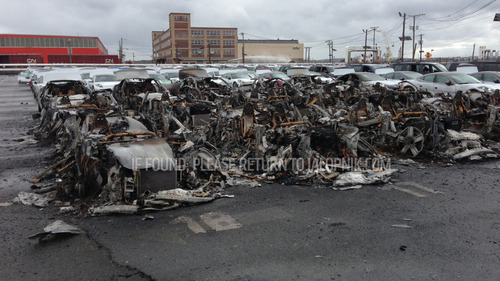
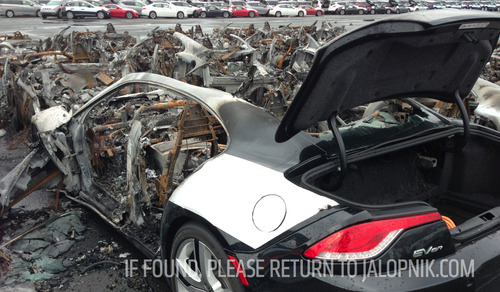
As if the Fisker Automotive story isn't bad enough already, it gets worse. It's being reported that over a dozen Fiskers caught fire and literally blew up in a New Jersey port right after Hurricane Sandy hit.

More Than A Dozen Fisker Karma Hybrids Caught Fire And Exploded In New Jersey Port After Sandy
Approximately 16 of the $100,000+ Fisker Karma extended-range luxury hybrids were parked in Port Newark, New Jersey last night when water from Hurricane Sandy’s storm surge apparently breached the port and submerged the vehicles. As Jalopnik has exclusively learned, the cars then caught fire and burned to the ground.

Our source tells us they were “first submerged in a storm surge and then caught fire, exploded.” This wouldn’t be the first time the vehicles, which use a small gasoline engine to charge batteries that provide energy to two electric motors, had an issue with sudden combustion.

The vehicle, despite only being in limited production, has already experienced numerous fires due to equipment failures and electrical shorts. How, exactly, they caught fire after being submerged in sea water is unclear. It’s possible the salt water caused a short that led to a fire.
As far as we know, no other vehicles caught fire and exploded as a result of Hurricane Sandy. Business Insider and Wired  have also reported on the Fisker cars that caught fire.  Zero Hedge especially had some fun with its headline:

Fisker Karma Is First Car To Burn Underwater  Zero Hedge

16 Fisker Karmas Caught Fire During The Hurricane  Business Insider

At Least 16 Fisker Karmas Drown, Catch Fire at New Jersey Port  Wired

Furthermore, the taxpayer subsidized Fisker has a long and problematic history.

Fisker Looking Into Another Karma Fire
Fisker Automotive has another fire to put out.

Fisker, the Anaheim, Calif.-based maker of luxury plug-in hybrid sports cars, says it is investigating why one of its Karma models caught fire Friday in a parking lot in Woodside, Calif.

For Fisker, images of one of its $100,000 cars mysteriously going up in flames represent another detour for the company’s efforts to regain momentum....

The Woodside fire comes as Fisker is fighting to rebut charges in the German magazine Autobild that the Karma’s design presents a high risk of fire. The company and federal and state officials also are investigating a May incident in which a Fisker Karma was one of three cars destroyed in a garage fire near Houston, Texas.

Late last year, Fisker recalled about 260 Karmas to fix potentially defective hose clamps that could lead to battery coolant leaks.

Meanwhile, Fisker’s been reshuffling its top management, and looking for new funding to replace a $529 million U.S. Energy Department loan that was frozen earlier this year after the company fell behind schedule in developing a new plug-in hybrid model, the Atlantic. Fisker has stopped work equipping a former General Motors Co. assembly plant in Delaware that had been targeted to build the car.
It appears clearly evident that Fisker's Karma has some really bad taxpayer funded karma and may end up being the worst vehicle ever manufactured.  But what the heck, it's only taxpayer cash!


How Sweet It Is! American Sugar Barons are Finally Being Challenged.


I'm thrilled that another component of the corporate welfare state is finally on the table for a real debate. The American sugar barons are a crime syndicate with heavy ties to Congress Critters but there may finally be a real fight brewing to dislodge the the power of the sugar barons and the fight is long overdue.

Big Candy Revives Sugar Fight On Halloween
The sugar industry wants the federal government's sugar program -- which places tariffs on most foreign sugar -- to continue as it is in the current farm bill. The candy industry wants it repealed or reformed.
The Coalition for Sugar Reform, which includes the National Confectioners Association, sent Congress a Halloween-themed message today. "The U.S. Sugar Program" is scrawled across the top in blood-dripping font and below are "four scary reasons" why the coalition wants Congress should reform the program, including manufacturing job losses and high costs to consumers.
An accompanying release from the coalition also quotes Reps. Joe Pitts, R-Penn., and Danny Davis, D-Ill., who call on Congress to reform the sugar program.
"Halloween reminds us that while the sugar program is a treat for wealthy farmers who benefit from the sugar subsidies, it's nothing but a trick for the millions of American families who pay a hidden tax on sugar every time they go to the grocery store," Pitts said in the release.
On the other end of the fight is the American Sugar Alliance, which casts the candy industry's release as being in poor taste...
Not only have the sugar barons been ripping off American consumers for decades, sugar subsidies have also cost America thousands of  candy manufacturing jobs as candy producers flee to nations with much lower sugar prices because sugar is a major ingredient of candy. Sugarreform.org, which is an excellent source of information on sugar and government subsidy programs, has posted some documented facts on what the thieving sugar barons have imposed on us.
Think Tanks

Last month, Americans paid 49 percent more for raw sugar than if they were allowed to freely import it. Clearly the sugar program is not a ‘no-cost’ policy, as sugar producers assert, since it increases prices for everyone who buys sugar or products that contain sugar.”

—The Heritage Foundation, “End the U.S. Sugar Program,” blog post, June 6, 2012

“Under this central planning scheme, the federal government restricts the sugar supply, fixes the domestic price at high levels and keeps out competition. Despite record world prices for sugar, the program continues to impose unnecessary price supports, strict production and marketing controls and outdated import quotas. The program is counterproductive, antithetical to a free market economy and has long outlived its usefulness.”

—Fran Smith, Board Member and Adjunct Fellow, Competitive Enterprise Institute, “Sugar Program Isn’t Sweet for Consumers or the Economy,”
Op-ed in The Daily Caller, April 19, 2012

“Government interference in the sugar market hurts consumers and food manufacturers by driving up the price of sugar, threatening competitive farmers and ranchers by jeopardizing export growth, and weakening the U.S. economy by diverting resources from more competitive uses. This Depression-era program, which was supposed to end in 1940, has outlived its intended lifespan by 72 years. It should be abolished.

—The Heritage Foundation,“The U.S. Sugar Program: Bad for Consumers, Bad for Agriculture, and Bad for America,” Policy Brief, April 18, 2012

The sugar program is a central planning system that makes consumers pay more for many foods and beverages, means real jobs lost in sugar-using companies, and shuts developing countries out of important markets.

—Christine Hall, Competitive Enterprise Institute, March 30, 2011

The federal government has been meddling with sugar production since 1934. Today’s convoluted system of supply controls, price supports, and trade restrictions benefits domestic sugar producers at the expense of consumers and utilizing industries. In other words, sugar producers “win” and the rest of the country ‘loses.’… The federal government engages in a lot of activities that are difficult to defend. But when it comes to sugar, the government’s protections are clearly indefensible.”

—Tad DeHaven, Cato@Liberty, Blog Post, March 30, 2011

The sugar program diverts billions of dollars from American consumers to the “Big Sugar” cartel and would understandably make sense to the members of the American Sugar Alliance. But that very costly program certainly doesn’t make any sense at all for the millions of American consumers and thousands of U.S. businesses who were burdened last year alone with $4.5 billion in higher sugar costs.”

—Mark Perry, American Enterprise Institute, “Sugar Policy: Sweet Deal forProducers, Sour for Consumers,” Blog Post, January 24, 2011

“These policies impose a burden on consumers through higher prices. In recent years, USDA data show that U.S. sugar prices have been more than twice world market prices.

—Cato Institute, June 2009

“A ripe target for reform is the sugar program, which protects sugar growers and inflates domestic sugar to twice the world price. This racket costs U.S. families about $2 billion annually, hitting them whenever they buy chocolates, breakfast cereal and the like.”
 —Chris Edwards, Director of Tax Policy, Cato Institute,
 “Why Congress Should Repeal Sugar Subsidy,”
Op-ed in Investor’s Business Daily, June 20, 2007

Since US sugar prices are about double the global free market sugar price, US candy manufacturers are relocating, primarily, to Canada and Mexico. The exit of US candy manufacturers includes Brach's, Hershey, Fanny May, Kraft and more. Thousands of jobs in the US have been shed because of protectionist sugar pricing.  Chicago was once America's leading candy manufacturer but those candy producers have fled the US.

The free market think tank, Cato.org. summed up the sugar racket splendidly "The sugar program is essentially a producer cartel run out of Washington. The Agriculture Department operates a complex loan program to guarantee sugar growers certain prices, which it enforces with import barriers and domestic production controls.", here.

One think tank exposed the government's logic for sugar subsidies.  According to the government, sugar subsidies create US sugar manufacturing jobs.  However, for every sugar producing job that is created through sugar baron subsidies, at least 3 more jobs are lost.  That's government math in action!

Will consumers and free market capitalism win the sugar baron battle?  When it comes to dethroning America's corporate welfare queens it's always an uphill battle.  However, public awareness is growing and that translates to political pressure.  Congress isn't listening.

Sour vote on sugar
June 16,2012
THE U.S. SENATE this week narrowly missed an opportunity to make progress in restoring fiscal sanity to Washington.
By a 50-46 vote Wednesday, the Senate defeated an amendment to the farm bill that would have phased out price supports and quotes to the sugar industry.
The sugar barons remain a very wealthy and powerful lobby that lavishly fills campaign coffers and the buying of politicians is what the subsidy game is all about. At the core of the DC Wheel of Fortune's Pay to Play game lies a big pot of fascist gold - monopolies and taxpayer cash.

Political corruption is not without profound geo-political consequences. When the sugar barons successfully lobbied Congress to embargo Cuban sugar to avoid competition and strengthen their own cartel power, Cuba lost vital revenues from its critically important sugar crop. This drove Castro straight into the orbit of the Soviets who bought Cuban sugar. Moreover, the US decision NOT to peacefully trade with Cuba on any level resulted in human suffering and a vastly strengthened Cuba-Soviet alliance. We got the Cuban Missile Crisis and a botched CIA engineered invasion of Cuba.

Isn't American crony capitalism just great!!