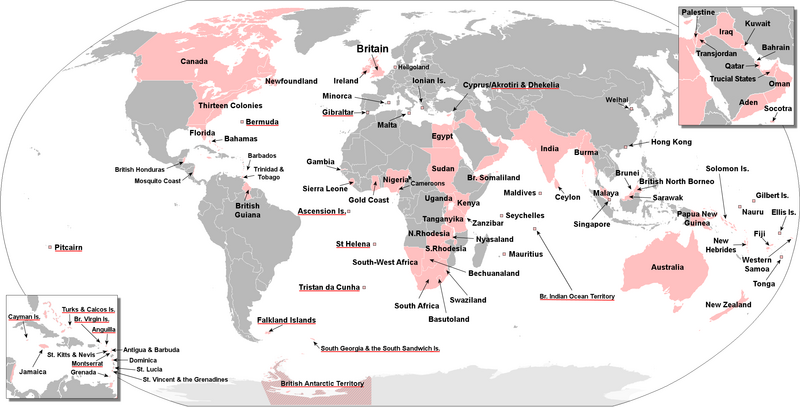
Most of those British colonies and possessions are now gone and even Canada and Australia are sovereign nations with little attachment to the British crown.
Throughout human history, the fight for human liberty has been a revolt against government, the state, empires and their formidable military machines. The British Empire grew because its formidable navy ruled the seas for hundreds of years.
America and Britain have a lot in common, starting with the fact that America was largely settled and populated by English speaking peoples who adopted English law and culture. The English bequeathed to us some extraordinary gifts such as its system of secure property rights and a civil and criminal legal justice system (English common law). The Magna Carta is deemed one of the great treasures of western civilization because the 1215 document directly challenged absolute rule by a monarch.
However, America also adopted some of the worst features of the British, namely its perennial addiction to empire, resource exploitation and the perceived right to plunder and murder people to secure resources. Furthermore, the British were never capitalists in the true sense of the word. They were merchantilists.
Mercantilism in England
Celebrating America's Capitalist Revolution
The British system of mercantilism is not capitalism and in fact is more closely aligned with fascism, oligarchy, plutocracy, cronyism, corporatism etc., or in more simple terms the rule of the elites for their exclusive benefit, benefits that typically include monopoly powers and buying legislative bodies to guarantee protectionism from competition.
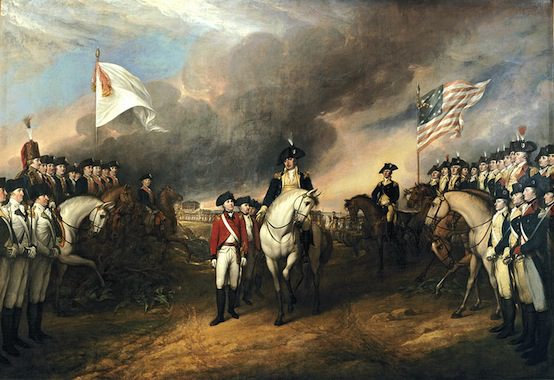
In many ways, the American Revolution was also a revolt against the British system of mercantilism but only to a degree because America during the Revolutionary period was also swimming with British loyalists and while many of these loyalists joined the Revolution, they remained addicted to the British system of mercantilism, empire, its central bank and even its system of monarchy. Notable among American mercantilists was Alexander Hamilton. Hamilton forever denied that he was a monarchist, although he was constantly defending himself against the charge.
A Hamilton biographer, Richard Brookheiser, wrote in a biography titled Alexander Hamilton, American:
He put up with Republican government because he had to, while laboring to transform it, or even subvert it. At heart he was an aristocrat and a plutocrat, who favored rule by an elite of the rich.The differences between Jefferson and Hamilton couldn't be more clear. As excerpted from The Creature from Jekyll Island by G. Edward Griffin:
JEFFERSON: “A private central bank issuing public currency is a greater menace to the liberties of the people than a standing army.” “We must not let our rulers load us with perpetual debt.”
HAMILTON: “No society could succeed which did not unite the interest and credit of rich individuals with those of the state.” “A national debt, if it is not excessive, will be to us a national blessing.”
Hamilton only cared about advancing the interests of the rich and the state at the expense of the individual and those further down the ladder of power and money, especially the poor and middle class whose interests were deemed expendable and irrelevant. Conversely, Jefferson vehemently opposed any bank or class of people holding power over anybody. Hamilton's view of power was that it must be concentrated while Jefferson's view of power was that it must be diffused as far and wide as possible and to the point where political power just lacks the power to oppress.
At the end of the day it was Hamilton who won, and of course, the liberty of the American people was destined for eventual destruction.
The worst and most destructive features of Britain that America embraced were its systems of central banking and economic mercantilism because both ruthlessly combined to advance empire through debt and fascist corporatism through trade. It's a deadly combination that has wrecked havoc upon humanity and its peoples.
It took Hamilton a long time to achieve his dream, a dream that only his ghost can now gloat over. Efforts to fight off the central bank were waged ferociously, especially by Andrew Jackson, but tragically in 1913 the bankster purveyors of paper fiat money finally won, and not surprisingly, with the support of liberal progressive Democratic President Woodrow Wilson who also gave us the income tax or 16th amendment . America has been at war practically non-stop since we got the Federal Reserve and the purchasing power of the dollars has dropped by at least 95% because, above all, a central bank is nothing more than a vehicle to transfer wealth from the poor and middle class to the rich.

The rich never suffer a loss of wealth from central banking operations, largely because mechanisms are in place to protect powerful insider financial interests from the loss of wealth by directly subsidizing any losses. But the most ugly legacy of the Federal Reserve and the central banksters in general is that they successfully spread their poisonous central banks and mercantilism throughout the world.
While the Federal Reserve has now replaced the Bank of England as the world's most powerful central bank, its also true that Britain, its mercantilism, its empire and its fiat banking system have all survived across the the pond where these anti-liberty institutions have grown even more powerful, dangerous and deadly.
Bankster power has been absolute for quite a long time and includes the draconian powers of government to squash human liberty at every turn while waging perpetual warfare for resources to plunder. But the banksters have an Achilles' heel that was exposed in all its naked glory in the 2008 financial meltdown. While central banks scrambled to to keep the world's central banks from totally imploding, it's also quite likely that the banksters are finally on angels wings. Printing insane amounts of fiat money to bailout the rich at the expense of the poor and middle class has left the global economy tettering on the brink of collapse and $16 trillion is a most threatening pile of debt fueled fiat money.
Have You Heard About The 16 Trillion Dollar Bailout The Federal Reserve Handed To The Too Big To Fail Banks
While the dollar only survives because of its lofty and prestigious status as the world's reserve currency, it's not necessarily a guarantee or even a foregone conclusion that the dollar will remain the reserve currency of the world. The dollar isn't the world's reserve currency because it's such a great currency but because all other currencies are either much worse and/or even more unstable for purposes of international trade.
There are signs that the dollar will ultimately be challenged and such challenges will come from nations that are stockpiling gold for future use in creating gold backed currencies.
Putin is Stockpiling Gold
According to the World Gold Council, Russia has more than doubled its gold reserves in the past five years. Putin has taken advantage of the financial crisis to build the world’s fifth-biggest gold pile in a handful of years, and is buying about half a billion dollars’ worth every month.The Hoarding Continues: China Purchases A Record 100 Tons Of Gold In April From Hong Kong
Gold imports by mainland China from Hong Kong climbed 65 percent to a record in April, advancing for a third straight month as investors sought a hedge against financial-market turmoil and an economic slowdown....The probability that gold backed currencies will rise to challenge the supremacy of the paper tiger US dollar keeps growing and now appears to be a certainty even if the timing of such events is unclear.
"We can’t rule out the possibility that the central bank is buying gold,” said Wang at Agricultural Bank of China, referring to the People’s Bank of China.
Rule out? You can bet on it.
The bad news is that the American people will suffer greatly as the once mighty United States of America joins the heap of being nothing more than just another failed and bankrupt banana boat republic. Few Americans even understand that our $16 trillion debt mountain that sustains our fictitious standard of living is the leverage that America uses to force other nations to buy Treasuries. Effectively, America went to nations like China and said in so many words "buy our debt and we'll buy your goods. We don't even care if American domestic manufacturing ceases and desists because we only care about the continuity of the Empire, whatever the price". This is so Hamiltonian and so anti-Jefferson. The price was more than the cost of interest, America sacrificed its legendary domestic manufacturing, the lifeblood of any prosperous society, for the glory of an Empire of Debt that was identical the British model of empire.
The silver lining is that while there will be profound hardships for the American people as they struggle to survive amid the bankster induced carnage, hope lies in the fact that we can once again have the opportunity to rebuilt the free and prosperous nation that we once had but willingly voted to sacrifice on the alter of empire and debt.
When the British Empire finally dies, along with its model of central banking, mercantilism and empire, the world will finally have a chance at real hope, real change and a future of peace, liberty and prosperity.
In the high risk, high stakes game of geo-politics, nothing is ever static although it moves very slowly. Still, there is ample evidence surfacing that the major shift in power is underway, from the Anglo-sphere to the rise of new economic paradigms in other nations who are embracing sound money and economic liberty.
Meanwhile, I can only opine that Americans abandoned their prosperous Republic, unlike the the Swiss who kept their republic, steered clear of wars and foreign intrigues, and still remain one of the most peaceful and prosperous folks on the planet and in human history.
Americans? We had it all and blew it.